What Coaches Say Shapes What Players Decide
Updated: Aug 10
Even when its not the best decision for players to make
Coaches and their instructions
Coaches give instructions. That much is obvious. But how those instructions are framed — and what they direct players' attention toward — has a measurable effect on the quality of decisions players make in the game. This is the central finding of a 2021 study by Adam Beavan and Job Fransen, published in the open-access Journal of Sport and Exercise Science.
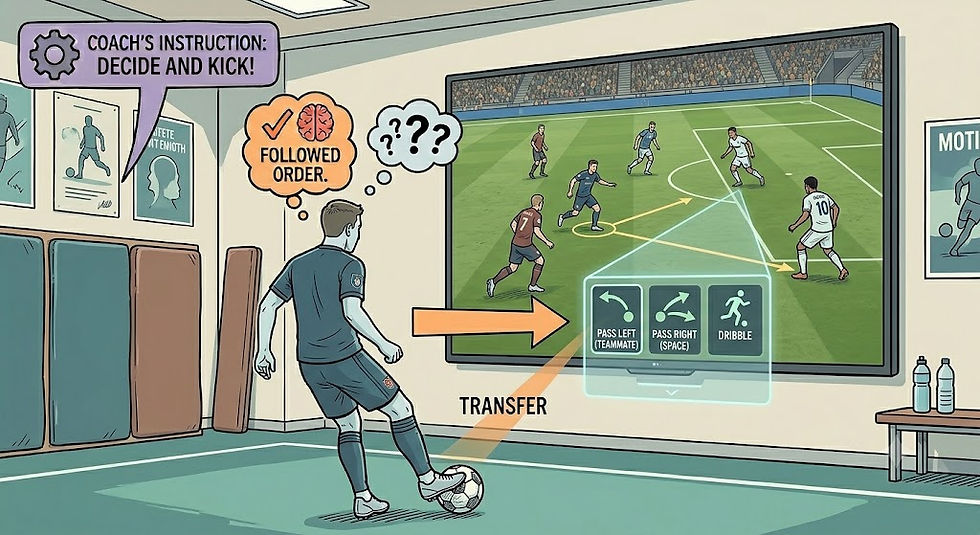
The study asked a straightforward question: does the type of coaching instruction influence decision-making in soccer? Two instruction conditions were compared. In one, players received explicit, outcome-focused instructions telling them what decision to make (for example, directing them to pass to a specific teammate). In the other, players were given attentional instructions that directed their focus toward relevant information in the environment — cues that would help them make a good decision themselves.
Players (mostly) decide what you tell them to, even when you're wrong
The findings support what skill acquisition researchers have suspected for some time: instructions that direct players' attention to relevant environmental information lead to better decision-making than instructions that simply tell players what to do. When players are told the answer, they follow instructions in that moment - but they don't develop the perceptual skill to read the game themselves. When players are directed toward the right cues, they build the capacity to make good decisions independently.
This has direct implications for how coaches structure training sessions and communicate with players. Explicit, prescriptive instructions can be useful for beginners who need a framework to work from, but over-reliance on them in advanced players may limit decision-making development. Instructions that prompt athletes to look for specific information — the positioning of defenders, the movement of a teammate, the shape of space — appear more effective for building genuine game intelligence.
Instructions, information and representive learning design
The research also connects to the broader principle of representative learning design: practice environments should preserve the perceptual information that players need to make good decisions in competition. Coaching instructions are part of that environment. What a coach says, and how they say it, shapes what players attend to — and ultimately, the quality of decisions they make under pressure.
For coaches at any level, the lesson is straightforward: talk less about outcomes, and more about cues.
Based on: Beavan, A., & Fransen, J. (2021). The influence of coaching instructions on decision-making in soccer. Journal of Sport and Exercise Science, 5(1), 3–12. [Open access — freely available at jses.net]


Comments