Agility is Not Just Physical
Updated: Aug 10
But that also makes it hard to measure and train
Agility as a perceptual-motor skill
When a footballer sidesteps a defender, is that a physical skill or a perceptual one? The honest answer is: both, and separating them may be part of the problem.
A 2025 paper in Sports Medicine Open - fully open access - brings together two researchers with apparently opposing views on agility training to find out how much they actually disagree.
Jordan Cassidy, an advocate of ecological dynamics who argues that agility is fundamentally about coupling perception and action in representative environments, and Daniel Kadlec, a strength and conditioning specialist who emphasises physical preparedness and questions the evidence for specialist perceptual training, agreed to a structured, moderated dialogue. The moderator was sport scientist Job Fransen.
The result is a rare piece of honest scientific exchange - and the headline finding is surprising: the two adversaries agreed far more than they disagreed.
Both converged on the view that agility cannot be reduced to isolated components. A sidestep is not just a physical movement - it is a perceptual-motor action, shaped by what the athlete can see, anticipate, and physically execute at the same time. Both agreed that an athlete's physical capacity directly shapes what they can perceive and act on: a stronger, faster athlete can delay their decision longer, wait for more reliable information, and execute a wider range of responses. This means physical preparation and perceptual skill development are not competing priorities — they are intertwined.
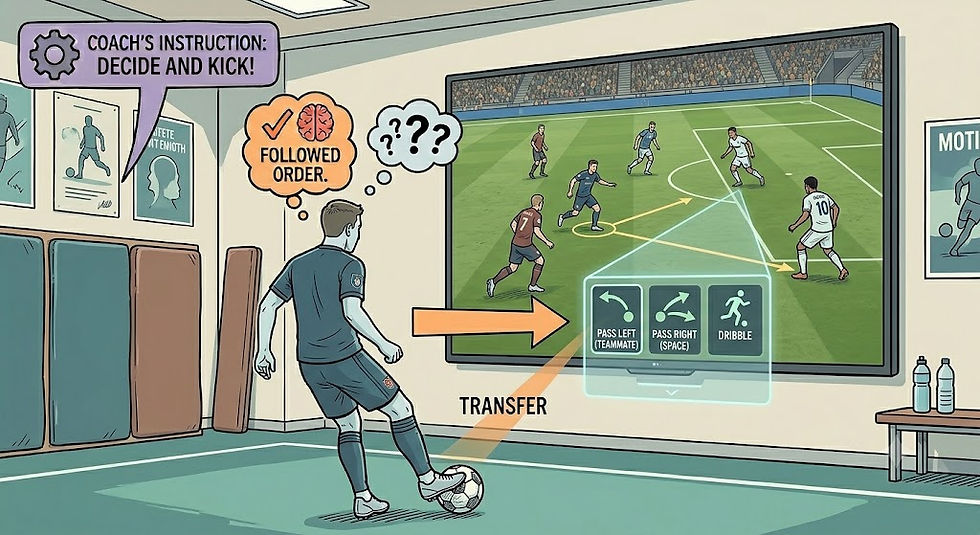
Both also agreed that training agility in decontextualised, lab-like settings is unlikely to transfer to game performance. Agility only develops meaningfully when athletes are exposed to the perceptual information they will actually encounter in competition — the movement of opponents, spatial cues, time pressure.
Where disagreement remained was narrower: how to assess perceptual-motor agility reliably, and whether strength and conditioning sessions (outside of sport-specific practice) can be designed to meaningfully develop game-relevant agility or whether sport-specific practice is the only effective context for that.

Adversarial collaboration to move us forward
The paper also demonstrates the value of its method. Adversarial collaboration - where researchers with opposing views answer the same questions transparently, moderated by a neutral third party - is a powerful antidote to echo chambers. It forces assumptions into the open and produces testable hypotheses both parties can agree to investigate together.
For practitioners, the practical message is this: neither pure physical preparation nor isolated perceptual training is sufficient. The best agility development probably combines both — building physical robustness while designing practice that preserves the perceptual demands of real competition.
Based on: Cassidy, J., Kadlec, D., & Fransen, J. (2025). Exploring convergence and divergence in seemingly contrasting perspectives on training perceptual-cognitive abilities for sports performance through moderated dialogue. Sports Medicine Open, 11, 101. [CC BY open access — freely available at Springer Nature]


Comments